Electric Vehicles
Vehicle-to-grid: the idea that keeps not arriving
A parked fleet of electric cars is an enormous distributed battery, and every attempt to use it runs into the same obstacles.
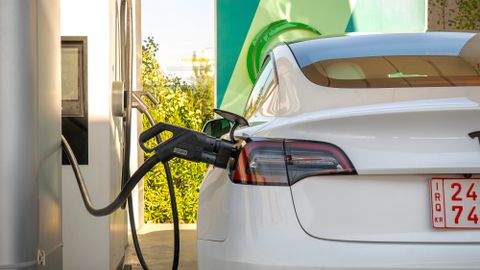
Cars are parked around ninety-five percent of the time. Each contains a battery comparable to several days of a household's electricity use. The arithmetic of using that capacity is compelling and has been for fifteen years.
The variants
Three distinct propositions frequently conflated.
Vehicle-to-load. The car powers appliances directly through an outlet. Simple, already shipping on several vehicles, genuinely useful for camping and for power cuts.
Vehicle-to-home. The car powers the house through a bidirectional charger and a transfer switch, either during outages or to shift consumption away from expensive periods.
Commercially available and growing.
Vehicle-to-grid. The car exports to the network, participating in grid services and being paid for it.
The most valuable in principle and the least deployed.
Why it should work
Grids need short-duration flexibility: frequency regulation, evening peak support, absorbing midday solar surplus.
A fleet of parked EVs is well suited to all three. The batteries exist and are paid for; the marginal cost of using them is the degradation and the hardware.
Aggregating even a modest fraction of a national fleet gives capacity comparable to large grid storage installations, distributed across the network where the load actually is.
Why it has not happened
Hardware cost. Bidirectional power electronics are more expensive than unidirectional. Whether the inverter sits in the car or the wall charger has been an unresolved architectural argument, and both approaches have shipped.
Standards fragmentation. Multiple communication protocols and connector standards, with support varying by vehicle, charger and market. A customer cannot reliably assume a given car works with a given bidirectional charger.
This is improving as standards converge, and it has cost the sector years.
Warranty. Manufacturers have been cautious about permitting bidirectional operation, because additional cycling affects degradation and therefore warranty exposure.
Several now support it explicitly, which was the necessary unlock.
Degradation, honestly assessed. Additional cycles do age a pack. The size of the effect depends heavily on depth of discharge, rate and temperature.
Shallow, slow cycling — which is what grid services mostly require — has a modest effect. Deep daily cycling has a larger one.
Studies have reached varied conclusions, and a reasonable summary is that carefully managed V2G is not obviously damaging and that unmanaged deep cycling would be.
Market access. The largest non-technical barrier.
Grid service markets were designed around large generators. Participating requires meeting minimum capacity thresholds, metering standards and settlement processes that a single car cannot meet.
Aggregators exist to pool vehicles into a market-eligible resource, and the regulatory permission for that varies enormously by jurisdiction.
Interconnection. Exporting to the grid requires approval from the network operator, with anti-islanding protection and equipment certification. The process is designed for rooftop solar and is not always adapted for vehicles.
The user question
Frequently underestimated.
A driver's requirement is that the car has enough charge when they need it. Any system that risks failing that will be switched off after the first incident.
Which means the control system must respect a user-set departure time and minimum charge, and must be conservative. That conservatism reduces the capacity actually available to the grid.
Well-designed systems handle this transparently — the user sets when they leave and how much they need, and the system optimises within it.
Smart charging first
The unglamorous point.
Most of the grid benefit available from EVs comes from managing when they charge, not from discharging them.
Shifting a fleet's charging away from the evening peak and into overnight or midday surplus periods is a large flexibility resource requiring only unidirectional hardware and a communication link.
It is cheaper, simpler, already deployable and largely underused. Time-of-use tariffs achieve much of it with no technology at all beyond a timer.
Where it is actually happening
Fleet applications, which solve several problems at once: predictable schedules, single ownership, depot charging and enough aggregate capacity to meet market thresholds.
School buses are the standout case — large batteries, fixed routes, and idle all summer when grid demand peaks.
Whether it reaches private vehicles at scale depends less on the technology than on whether the market rules and the standards get tidied up.