Robotics
Industrial robots: what the installed base actually does
Several million arms are working in factories today, doing a narrower set of tasks than most people imagine.
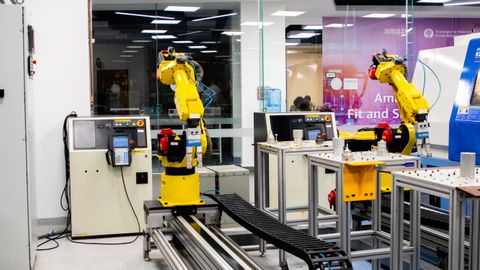
Industrial robotics is a mature industry with millions of units installed worldwide. What those machines actually do is more limited and more interesting than the general impression.
The dominant applications
Welding. Historically the largest single application. Spot welding in automotive body shops is close to universally automated.
The task suits robots perfectly: fixed part positions, repeated identical motions, a hostile environment for humans, and quality that depends on precision and repeatability.
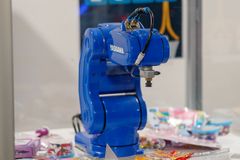
Material handling. Moving parts between machines, loading and unloading, palletising.
The largest category by unit count, and mostly unglamorous pick-and-place between known positions.
Painting and coating. Fumes, consistency requirements and the difficulty of maintaining an even finish by hand.
Assembly. Growing and still the hardest, because assembly involves contact, force control and tolerance stack-up.
Dispensing, applying adhesives and sealants along precise paths.
Machine tending, loading CNC machines, which is repetitive and requires no dexterity.
Notice what is absent: anything requiring the robot to identify an unfamiliar object, adapt to an unexpected situation, or work in an unstructured space.
The economics of integration
The number that determines whether a project happens.
The robot arm is frequently a minority of the total installed cost. The remainder is end-of-arm tooling, fixtures, safety systems, controls integration, programming, commissioning and the engineering time to design it all.
Integration cost has historically run to a multiple of hardware cost, which is why automation favours high-volume production: the fixed engineering cost is amortised across many parts.
Low-volume, high-mix manufacturing — which is most manufacturing by establishment count — has been much harder to automate for exactly this reason.
What has changed recently
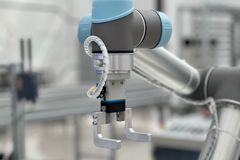
Collaborative robots. Force-limited arms designed to work near people without full cages.
They are slower and lower payload than traditional industrial arms, and they eliminate the safety fencing and the floor space it requires, and they can be redeployed between tasks.
This opened automation to smaller manufacturers who could not justify a caged cell.
Note that collaborative operation is a property of the application and its risk assessment, not of the robot alone — a force-limited arm holding a sharp tool is not inherently safe.
Easier programming. Lead-through teaching, where an operator physically guides the arm through a path, and graphical programming have reduced the specialist skill required.
This attacks the integration cost directly, which is where the barrier actually was.
Vision. Cheap, capable machine vision means parts no longer need to arrive in precisely fixed positions. Bin picking — retrieving parts from a jumbled container — has moved from research problem to commercial product for many part types.
This removes a great deal of expensive fixturing.
Force sensing. Necessary for assembly tasks involving insertion and contact, and now standard rather than exotic.
Where the density is
Robot density — units per ten thousand manufacturing workers — varies enormously between countries.
The leaders are concentrated in East Asia and northern Europe, driven by automotive and electronics manufacturing, high labour costs and sustained industrial policy.
The correlation with manufacturing employment is not what the popular argument assumes: several of the most robot-dense economies also have large and stable manufacturing workforces.
That does not settle the question of automation and employment. It does mean the simple substitution story is not supported by the cross-country data.
What still resists automation
High-mix low-volume work, where the setup cost per part dominates.
Flexible materials. Cloth, wire harnesses, gaskets and cables deform unpredictably, which defeats rigid-body assumptions in planning and vision. Garment manufacture remains stubbornly manual for this reason.
Final assembly of complex products, which involves many small varied tasks in confined spaces.
Inspection requiring judgement, though machine vision is closing on defined defect classes.
Anything in an unstructured environment, which is the general case and the reason construction and agriculture automate more slowly than factories.
The realistic direction
Not androids replacing workers, but continued reduction in integration cost — better vision, easier programming, standardised tooling and simulation-based commissioning.
Each increment brings automation within reach of a smaller production run, which is where the remaining market is.