Robotics
Surgical robots and what teleoperation actually buys
The most commercially successful medical robot is not autonomous at all — it is an extremely good remote control, and that turns out to be the point.
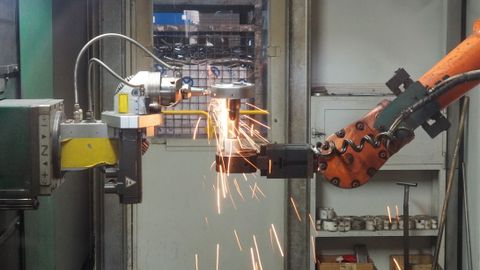
Robotic surgery is among the largest robotics markets by revenue, and the systems involved make no decisions. A surgeon controls them directly.
What the robot provides
Motion scaling. A large hand movement becomes a small instrument movement, so fine work becomes proportionally easier.
Tremor filtering. Physiological tremor is removed, which matters at millimetre scale.
Wristed instruments. Conventional laparoscopic instruments are rigid rods with limited articulation. Robotic instruments have wrists inside the body, restoring degrees of freedom that keyhole surgery removes.
Stereoscopic vision with magnification, restoring depth perception that a flat laparoscopic display loses.
Ergonomics. The surgeon sits at a console rather than standing in an awkward posture for hours.
That last item is undervalued. Surgeon musculoskeletal injury is a real occupational problem, and it affects career length.
What it does not provide
Autonomy. Every motion is commanded. The system does not decide anything.
Haptic feedback, mostly. Force feedback in commercial systems is limited or absent, so surgeons compensate visually — judging tissue tension by observing deformation.
Experienced operators adapt well. It remains a genuine loss relative to open surgery.
The evidence, honestly
Worth stating carefully, because the marketing outruns it.
For some procedures — notably radical prostatectomy — robotic approaches became dominant rapidly. Trials have generally found comparable oncological outcomes to open surgery with less blood loss and shorter hospital stay, and differences in functional outcomes that vary between studies.
For several other procedures, randomised trials comparing robotic to conventional laparoscopic surgery have found little difference in patient outcomes, with longer operating times and higher costs for the robotic approach.
The consistent finding across specialties is that the robot helps most where the conventional alternative is technically hardest — deep in the pelvis, in confined spaces, with fine reconstruction.
Where laparoscopic surgery is already straightforward, the robot adds cost without adding much.
The other consistent finding is that surgeon volume and experience predict outcomes more strongly than the platform does.
The cost question
Capital cost is substantial, instruments are consumable with limited reuse counts, and service contracts are significant.
Health economic analyses generally find robotic surgery more expensive per case, with the difference narrowing as case volume rises and as competition arrives.
The market has been dominated by one platform for two decades; expiring patents have brought competitors, and price effects are beginning to appear.
The training question
An underdiscussed consequence.
Trainees learning on a robotic system have a different learning curve from those learning open or laparoscopic technique, and there is legitimate concern about whether open surgical skills are maintained for the cases that require them.
Simulation has improved substantially and is now a standard part of robotic training, which is a genuine advantage — a surgeon can practise without a patient, which is not true of open surgery.
Where autonomy is creeping in
Carefully, in narrow tasks.
Orthopaedic systems perform bone cutting along a pre-planned trajectory derived from imaging, with the surgeon guiding and the system constraining motion to the plan. This is closer to a precise power tool with boundaries than to autonomous surgery.
Research systems have demonstrated autonomous suturing of soft tissue in animal models, which is a genuinely difficult problem because tissue deforms.
The regulatory path for autonomous surgical action is long and undefined, and the liability question is unresolved.
Remote surgery
Long-promised and rarely practised.
The technical obstacle is latency: teleoperation with force-relevant feedback degrades quickly beyond a few tens of milliseconds of round-trip delay.
Demonstrations over long distances have been performed, including recent ones using low-latency networks. Whether it becomes routine depends less on technology than on regulation, licensing across jurisdictions, liability and the availability of a surgical team at the patient's end regardless.
The general lesson
The most successful medical robot succeeded by amplifying a human rather than replacing one.
That pattern — machine handles precision and stability, human handles judgement — recurs across every domain where robotics has actually worked, and it is a more reliable guide to what will succeed than autonomy demonstrations are.