Robotics
Warehouse robotics: the automation that actually happened
While humanoids get the attention, wheeled robots quietly became one of the largest deployed automation categories in the world.
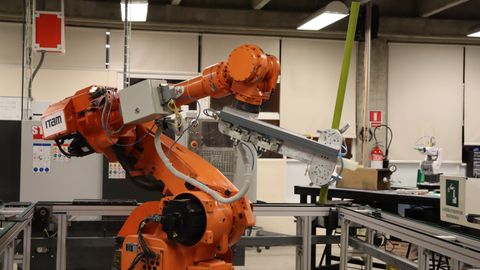
The most successful mobile robotics deployment of the past decade happened in fulfilment centres, using machines that look nothing like people.
The insight
Traditional warehouse picking sends a worker walking to shelves. Walking is most of the labour.
The change was to move the shelves instead: low wheeled units drive under a mobile shelving pod, lift it, and bring it to a stationary human picker.
The human stays put and performs the one task that remains genuinely difficult for a machine — recognising and grasping an arbitrary object.
This is the pattern that makes robotics work commercially: identify the part of the task that is structured and repetitive, automate that, and leave the unstructured part to a person.
Why the environment matters
A fulfilment centre can be designed around the robots.
Floors are flat and clean. Markers or fiducials on the floor provide reliable localisation. Lighting is controlled. Human access to robot areas is restricted, which relaxes the safety constraints enormously. Traffic is centrally coordinated rather than negotiated between machines.
Almost none of that is available in a home, a street or a construction site — which is exactly why robots succeeded here first and remain rare elsewhere.
The coordination problem
Thousands of units operating in one building is a fleet management problem more than a robotics one.
A central system allocates tasks, plans routes, resolves conflicts, schedules charging and manages congestion.
The interesting engineering is in throughput optimisation: which pod to fetch, which picker to send it to, how to place inventory so that frequently ordered items sit near the picking stations.
That last point is a genuinely clever emergent behaviour — inventory arranges itself by demand without anyone designing a layout.
What remains hard
Grasping arbitrary items. The persistent constraint.
A general-purpose picker must handle a deformable bag, a rigid box, a fragile item and something in a slippery polybag, presented in an unknown pose in a cluttered bin.
Progress has been substantial — suction grippers with learned grasp selection now handle a large share of typical inventory — and the residual failure cases are where the difficulty concentrates. Picking systems are generally deployed with human exception handling.
Unloading containers. Densely packed, heavy, unstructured, and physically demanding for humans. Several systems exist and it remains an active problem.
Anything requiring judgement, including damage assessment and handling the unexpected.
The labour question
Worth addressing directly rather than avoiding.
The evidence is mixed and specific.
Automation of this kind has generally increased throughput per facility and shifted the job content — less walking, more repetitive picking at a fixed station, at a pace set by the system.
That change is not unambiguously an improvement. Reduced walking is easier on the body; a fixed station with machine-set pace and continuous measurement introduces different strains, and injury data and worker accounts have raised genuine concerns.
Employment effects at the facility level have varied. Aggregate warehouse employment in several markets has grown alongside automation, driven by e-commerce volume growth — which tells you about demand rather than about the counterfactual.
The honest summary is that the technology changed what the job is more than whether it exists, and that the terms of that change were largely set by employers rather than negotiated.
Where it goes next
Better picking, which is the single largest remaining labour component and the focus of most investment.
Autonomous mobile robots in less structured facilities — traditional warehouses, manufacturing plants, hospitals — using navigation that does not require floor markers.
Middle-mile and yard automation, moving trailers and containers within controlled sites, which is an easier environment than public roads.
Integration with inventory systems, where the gains are increasingly software rather than hardware.
The general lesson
The robots that succeeded did so by changing the environment to suit the machine rather than building a machine general enough for any environment.
That is a less exciting proposition than a humanoid walking through a factory, and it is the one that has moved billions of items.