Space
Space weather and why it matters more than it did
Solar activity affects satellites, power grids, aviation and navigation, and the exposure has grown considerably as infrastructure has electrified.
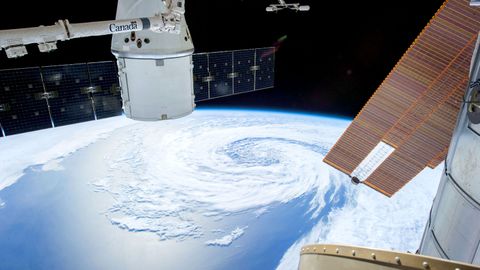
The Sun emits a continuous stream of charged particles and, episodically, much larger bursts. Both interact with Earth's magnetic field and upper atmosphere, with consequences for systems we increasingly depend on.
The phenomena
Solar flares. Sudden bursts of electromagnetic radiation, arriving at light speed. Effects on the ionosphere are immediate and disrupt high-frequency radio.
Solar energetic particles. High-energy protons arriving within tens of minutes to hours. Hazardous to spacecraft electronics and to crew, and a radiation concern for high-latitude aviation.
Coronal mass ejections. Large expulsions of plasma and magnetic field, taking one to three days to arrive.
When one strikes Earth's magnetosphere with the right orientation, it drives a geomagnetic storm — the source of aurorae and of the most serious infrastructure effects.
What geomagnetic storms do to power grids
The mechanism is indirect and important.
A rapidly changing magnetic field induces electric fields in the conducting Earth, which drive slowly varying currents through any long grounded conductor — including transmission lines.
These geomagnetically induced currents flow into transformer windings, where they partially saturate the core. A saturated transformer draws large reactive current, generates harmonics and heats up.
Consequences range from voltage instability and protective relay misoperation to transformer damage.
The 1989 storm that collapsed the Quebec grid within ninety seconds is the standard reference case. Large high-voltage transformers are custom-built with long lead times, which is why damage to several at once is the scenario planners worry about.
Risk is higher at high latitudes and in regions with resistive geology.
What they do to satellites
Surface and internal charging, which can produce discharges that damage electronics.
Single-event upsets, where an energetic particle flips a bit in memory or logic. Radiation-hardened designs and error correction mitigate this.
Atmospheric expansion. During storms the upper atmosphere heats and expands, increasing drag on low-orbit satellites.
This has real consequences: a batch of newly launched satellites was lost when a storm increased drag before they raised orbit. It also increases collision-avoidance workload, because orbital predictions degrade when drag is changing.
Navigation and communications
Satellite navigation signals pass through the ionosphere, and disturbances introduce timing errors and, in severe cases, loss of lock.
Precision applications — surveying, agriculture, aviation approaches, and the timing signals underpinning financial and telecommunications systems — are the sensitive cases.
High-frequency radio, still the backbone for long-range aviation and maritime communication in remote regions, degrades or blacks out during flares.
Aviation
Polar routes are exposed on three fronts: radiation dose at altitude, high-frequency communication blackout, and navigation degradation.
Airlines reroute during significant events, which costs fuel and time and is a well-established operational procedure rather than an exotic risk.
The forecasting problem
Space weather prediction is roughly where terrestrial weather forecasting was several decades ago.
A coronal mass ejection can be observed leaving the Sun, and predicting its arrival time to better than several hours, and its magnetic orientation at all, remains difficult.
Orientation is decisive: a southward-oriented field couples strongly to Earth's magnetosphere and a northward one largely does not. That is currently measurable only when the plasma reaches monitoring spacecraft upstream of Earth, roughly an hour before impact.
Which means the practical warning for the most consequential parameter is measured in tens of minutes.
The extreme case
The 1859 event usually named after the astronomer who observed it produced aurorae at low latitudes and induced currents strong enough to disrupt telegraph systems.
An event of that magnitude striking today's infrastructure is the standard planning scenario. Estimates of consequences vary widely and the qualitative picture is agreed: widespread grid disturbance, transformer damage, satellite losses and navigation disruption.
Historical records in ice cores suggest still larger events have occurred, which sets an uncomfortable upper bound.
What mitigation looks like
Grid operators can reduce loading, reconfigure networks and disconnect vulnerable transformers on warning. Series capacitors and neutral blocking devices reduce induced current flow.
Satellite operators can safe spacecraft, delay manoeuvres and suspend sensitive operations.
Airlines reroute.
All of it depends on warning, which depends on monitoring spacecraft — several of which are past design life and whose replacement has been a recurring funding question.
That is the least glamorous and most consequential part of space weather resilience.