Space
Starship-class vehicles and what fully reusable would mean
Recovering the second stage is the remaining hard problem, and solving it would change the economics more than booster reuse did.
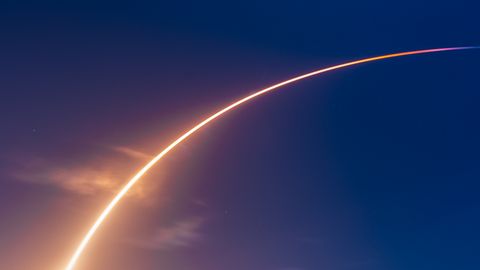
Booster reuse is now routine. Full reuse — recovering and reflying the upper stage as well — has not been demonstrated, and it is where the remaining order-of-magnitude cost reduction sits.
Why the second stage is harder
A booster separates well below orbital velocity, on a suborbital arc. It re-enters at a few kilometres per second, in a controlled attitude, with propellant reserved for braking.
A second stage reaches orbital velocity — roughly seven and a half kilometres per second. Returning it means dissipating all of that energy.
The thermal load is far higher and lasts far longer. This is the same re-entry problem crewed capsules face, applied to a large, elongated vehicle with a much less favourable shape.
And every kilogram of heat shield, landing hardware and reserve propellant comes directly out of payload — from a stage where payload margin is already thin.
The heat shield problem
Ablative shields, which char away carrying heat with them, are proven and single-use by definition.
Reusable shields must survive repeatedly without refurbishment, which is precisely where the Shuttle programme's costs concentrated: its tile system required extensive per-flight inspection and replacement.
Ceramic tile systems, metallic shields and transpiration cooling have all been proposed. The engineering requirement is brutal — survive many flights, tolerate impact damage, be inspectable quickly, and add minimal mass.
Whether any approach meets it in operation is the central open question.
What full reuse would change
If a vehicle could fly repeatedly with only propellant and inspection between flights, launch cost would approach the cost of propellant plus operations plus amortised vehicle cost divided by flight count.
Propellant for a large methane-oxygen vehicle is a small sum in absolute terms. Operations and amortisation would dominate.
The resulting cost per kilogram would be far below anything currently achieved, and — more importantly — the marginal cost of an additional launch would be small.
That is the change that matters. When marginal launch cost is low, the calculus for what is worth putting in orbit changes completely.
What becomes possible
Worth being specific, because the argument is frequently made vaguely.
Mass to orbit in bulk. Large space structures, propellant depots, and stations assembled from substantial modules rather than folded into small fairings.
Less mass optimisation. Satellite cost is driven partly by the extreme lightweighting that expensive launch demands. Cheap mass allows heavier, simpler, cheaper spacecraft.
Iteration. When a launch is affordable, hardware can be flown, found wanting and revised — the development model that made software and, latterly, launch vehicles themselves improve quickly.
Orbital refuelling, which is the enabling technology for anything beyond Earth orbit at scale, and which requires many launches per mission and is therefore gated on launch cost.
The realistic caveats
Cadence is not only about vehicles. Launch sites, range availability, regulatory approval and airspace coordination all constrain how often anything can fly.
Environmental scrutiny is rising. High-cadence launch has local effects — noise, debris, site ecology — and upper-atmosphere effects from exhaust and re-entry deposition that are genuinely under-researched.
Demand is uncertain. The commercial case rests on there being enough payload to fill high cadence. Constellations provide much of it; beyond that, demand at these volumes is projected rather than observed.
Reliability for crew requires a demonstrated flight record that takes years to accumulate, regardless of the vehicle's design.
What refurbishment actually involves
The step that separates reuse from rapid reuse.
Between flights a recovered stage requires inspection of structures, engines and thermal protection; replacement of consumables and any single-use components; and requalification before it is cleared to fly again.
Booster turnaround has fallen from months to weeks through a combination of design changes that reduce inspection scope and accumulated confidence about what does not need checking.
That second factor is underrated: much of the improvement came from data showing which inspections were unnecessary, which is only available after many flights.
An upper stage would begin that process from zero, which is why the first reflight matters less than the tenth.
How to read progress
The meaningful milestones, in order: orbital velocity achieved, controlled re-entry survived, upper stage recovered intact, upper stage reflown, and reflown with minimal refurbishment.
Each of those is a genuine step and several have not yet happened.
A test flight that ends in vehicle loss during a development programme is not necessarily a failure — iterative development expects it — and it is also not the milestone above.
The number to watch is turnaround time on a reflown upper stage. That single figure determines whether full reuse is an achievement or an industry.