Space
Space telescopes and why they cost what they do
An instrument that must work perfectly, first time, with no repair possible, at a temperature near absolute zero, folded to fit in a fairing.
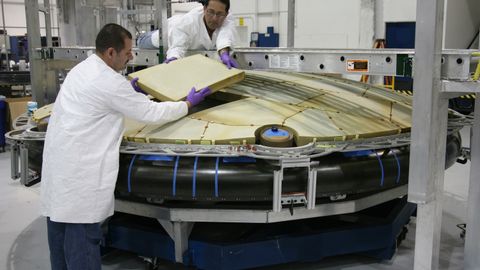
Flagship space observatories run over budget and behind schedule with a consistency that invites cynicism. The engineering reasons are worth understanding before reaching for it.
Why put a telescope in space at all
The atmosphere does three unhelpful things.
It blurs. Turbulence distorts incoming wavefronts, limiting ground-based resolution. Adaptive optics corrects much of this and works best over small fields and in the infrared.
It absorbs. Large parts of the electromagnetic spectrum — most of the infrared, all of the ultraviolet, X-rays and gamma rays — never reach the ground. Those wavelengths are only observable from above.
It glows. The atmosphere itself emits in the infrared, and so does any warm telescope, swamping faint sources.
The third point drives the hardest engineering: an infrared telescope must be colder than the things it is looking for.
The cryogenic problem
An infrared observatory must operate at tens of kelvin, and its detectors colder still.
Achieving that passively requires shielding from the Sun, Earth and Moon simultaneously, which is why such telescopes are placed far from Earth — typically at the second Lagrange point, roughly one and a half million kilometres out, where all three are in the same direction.
That location has a consequence: it is far beyond any possibility of a servicing mission. Every mechanism must work first time.
The sunshield itself is then a major engineering problem — a large, multi-layer, deployable structure whose failure would end the mission.
Why they are folded
Mirror diameter determines both resolution and light collection, so bigger is better in every respect.
Launch fairings are limited in diameter, so a mirror larger than the fairing must fold and deploy in space.
Segmented mirrors that unfold and are then aligned to a fraction of a wavelength — nanometre precision — introduce hundreds of single-point failures, each of which must be tested exhaustively on the ground in conditions that cannot fully replicate space.
Testing a structure designed to deploy in zero gravity, while it sits in Earth's gravity, is itself a substantial engineering exercise requiring elaborate support rigs.
This is where a great deal of the cost and schedule goes, and it is not obvious from outside.
Why costs overrun
Several structural reasons, none of them simple incompetence.
First-of-a-kind engineering. Every flagship observatory does something never done before, by definition — otherwise it would not be worth building. Estimating the cost of something nobody has built is unreliable.
No repair. The reliability standard is absolute, which means testing programmes that cost more than the hardware.
The one observatory that was serviceable was serviced repeatedly, including a mission to correct a manufacturing flaw — an option unavailable to anything beyond low Earth orbit.
Funding profile. Annual appropriations rarely match the optimal spending curve. Stretching a programme over more years raises total cost substantially, because standing army costs continue regardless of progress.
This is a large and frequently unacknowledged contributor.
Requirements growth. Long development periods invite additions, each individually reasonable.
Optimism at proposal stage, which is a structural feature of any competitive selection process.
What the results have been
Worth stating alongside the criticism.
Space observatories have produced results that reshaped fields: the accelerating expansion of the universe, atmospheric characterisation of planets around other stars, deep-field images that established galaxy formation timelines, and infrared observations of star-forming regions opaque at visible wavelengths.
The scientific return has generally been judged to justify the cost after the fact, by the same communities that criticised the overruns during development.
What might change the economics
Larger fairings. If a vehicle can launch a mirror without folding it, an enormous source of complexity disappears.
This is one of the more concrete benefits of larger launch vehicles, and it is rarely mentioned in the launch cost discussion.
In-space assembly. Building large structures in orbit rather than deploying them, which requires robotic assembly capability that is being developed.
Serviceability by design. Some newer concepts include grapple fixtures and modular instruments, anticipating robotic servicing.
Smaller, more numerous missions. A portfolio of modest observatories carries less programmatic risk than a single flagship, at the cost of not being able to do what only a flagship can.
The tension between those two approaches is a permanent feature of science funding argument, and both sides are right about something.