Space
Orbits, and why the choice constrains everything
A satellite orbit is not a location. It is a set of trade-offs about latency, coverage, lifetime and how many spacecraft you need.
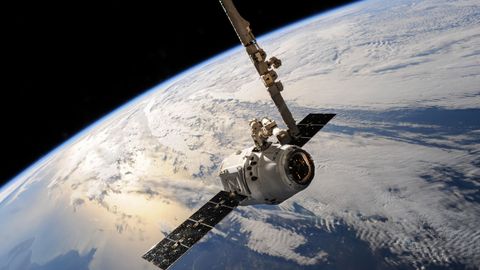
Where a satellite goes determines almost everything else about it: how many you need, how long they last, how much power they require, and how quickly a signal reaches the ground.
The main regimes
Low Earth orbit, broadly a few hundred to around two thousand kilometres.
Short orbital period — roughly ninety minutes — so any given satellite passes over a point on the ground briefly and frequently.
Low latency, because the distance is short. Low launch energy, so payloads are cheaper to place.
The cost is coverage: a single satellite sees a small area at a time, so continuous global service requires many of them.
Medium Earth orbit, in the thousands to roughly twenty thousand kilometres.
Used by navigation constellations. Longer periods, wider coverage per satellite, higher latency than low orbit.
Geostationary orbit, at approximately 35,786 kilometres above the equator.
At that altitude the orbital period matches Earth's rotation, so the satellite appears fixed in the sky. A ground antenna can point at it once and never move.
Three satellites provide near-global coverage excluding the poles. The costs are latency — the round trip is substantial and audible in conversation — and launch energy.
Sun-synchronous orbit, a near-polar low orbit whose plane precesses to keep a constant angle to the Sun.
Every pass over a given latitude happens at the same local solar time, which means consistent lighting for imaging. This is why Earth observation satellites use it.
The constellation arithmetic
The trade that has driven the past decade.
Low orbit gives low latency, which matters enormously for interactive traffic. It requires many satellites, because each covers a small footprint and moves quickly.
Continuous global coverage from a few hundred kilometres requires satellites numbering in the thousands, with the exact figure depending on altitude, beam design and how much of the globe you actually intend to serve.
That was economically impossible until launch costs fell and satellite manufacturing moved to something resembling mass production. Both had to happen together.
Drag and lifetime
Low orbit is not empty. Residual atmosphere produces drag, which decays the orbit.
Below roughly four hundred kilometres, an uncontrolled satellite re-enters within a few years. Higher up, the timescale extends to decades or centuries.
This cuts both ways.
Lower orbits self-clean: a failed satellite deorbits without intervention, which limits debris accumulation. That is a genuine argument for very low constellations.
They also require propellant to maintain altitude, which sets the operational lifetime. When station-keeping propellant runs out, the satellite comes down.
Solar activity varies drag substantially. During high solar activity the upper atmosphere expands and drag increases, which has caused real losses of newly launched satellites before they reached operational altitude.
Inclination and coverage
The angle of the orbital plane to the equator determines which latitudes are overflown.
An equatorial orbit never sees high latitudes. A polar orbit sees everywhere, at the cost of higher launch energy from most launch sites and less time over the populous mid-latitudes.
Constellations therefore use multiple inclinations — shells — to concentrate capacity where demand is, which is one reason the satellite counts are large.
Launch site latitude matters too. Launching due east from a low-latitude site gains the most from Earth's rotation; reaching a high-inclination orbit gives up that benefit.
Debris and congestion
The externality.
Collisions in orbit produce fragments, each of which is itself a collision hazard. A sufficiently dense debris population could, in principle, become self-sustaining — the scenario usually named after the researcher who described it.
Mitigation practice has tightened: deorbit requirements after end of mission, collision avoidance manoeuvres coordinated between operators, and improved tracking.
Whether the practice is sufficient at the constellation scale now being deployed is an open and actively argued question, and it is a governance problem as much as a technical one.
Reading a mission
When a satellite programme is announced, the orbit tells you most of the story.
Low orbit and a large number: latency-sensitive service, short satellite lives, high replacement cadence.
Geostationary and a small number: broadcast or wide-area coverage, long lives, high per-satellite value.
Sun-synchronous: imaging, with a revisit rate you can calculate from the number of satellites.
Everything else follows from that choice.