Electric Vehicles
Charging at home: what actually matters
The single decision that determines whether living with an electric car is convenient or tiresome, and it is mostly about electrical supply.
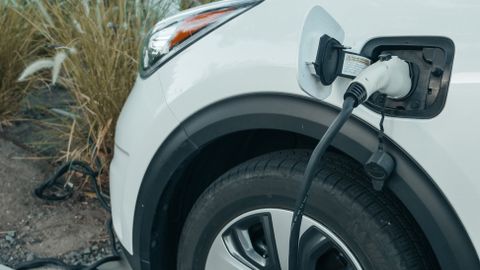
An owner with home charging plugs in when they arrive and never thinks about it. An owner without one plans their week around public infrastructure. Everything else about EV ownership is secondary to this.
What speed you actually need
Less than people assume.
A typical daily drive of forty to sixty kilometres consumes something in the region of eight to twelve kilowatt-hours.
A 7 kW home charger delivers that in under two hours. Over a twelve-hour overnight window it delivers far more than most drivers use in a week.
Which means the common instinct to buy the fastest available home charger is usually wasted money. The constraint is hours available, not kilowatts.
Note also that AC charging speed is limited by the car's onboard charger. Many vehicles accept 7 kW or 11 kW; installing a 22 kW unit for a car that accepts 7 gains nothing.
Single phase and three phase
The main determinant of what is available.
Single-phase domestic supply typically supports around 7 kW of charging. Three-phase supply, common in some countries and rare in others, supports 11 kW or 22 kW.
Upgrading a supply from single to three phase is possible and generally expensive, and rarely justified for charging alone.
The installation questions
Spare capacity. The main technical issue. A charger adds a substantial continuous load, and the existing supply must accommodate it alongside everything else.
Load management devices monitor total household draw and reduce charging current when other loads are high. This is frequently cheaper than upgrading the supply and is now common.
Earthing arrangement. In some supply configurations an outdoor charge point requires specific protective measures. A competent installer will identify this; it is a genuine safety matter rather than an upsell.
Cable route and distance. Longer runs cost more and may require heavier cable to limit voltage drop.
Tethered or socketed. A tethered unit has the cable attached, which is more convenient day to day. A socketed unit takes any cable, which matters if vehicles change.
Smart functionality. Scheduling, tariff integration and solar matching. Several jurisdictions now mandate smart capability on new domestic units so that charging can be shifted away from peak periods.
The tariff, which is where the money is
The largest financial variable in EV ownership, and the one most often left unexploited.
Time-of-use tariffs price electricity by period, with overnight rates that can be a small fraction of the day rate.
Charging entirely within a cheap overnight window can reduce per-kilometre fuel cost to a level that makes public rapid charging look extraordinarily expensive by comparison — frequently several times the home rate.
Some suppliers offer EV-specific tariffs with very low overnight rates in exchange for allowing the supplier to schedule charging within a window. For a driver with predictable habits this is close to free money.
The practical step: set the car or the charger to start only in the cheap window, and check that it actually did. Scheduling set in both the car and the charger can conflict, which is a common and irritating fault.
Solar
Attractive and more complicated than it looks.
Matching charging to solar generation requires the charger to modulate current in response to measured export, which several units support.
The complication is that a typical domestic array produces a few kilowatts at midday, while most cars are away at midday. Which means solar charging works best for people at home during the day, or with a home battery to buffer.
Where export payments are low relative to import prices, self-consumption is worth a great deal and the case is strong. Where export is well paid, it is weaker.
The granny cable
Every EV comes with a cable for a standard domestic socket, delivering roughly 2 to 2.5 kW.
That adds perhaps 10 to 15 kilometres of range per hour — enough to cover a modest daily commute overnight, and slow for anything more.
It is a genuine fallback and should not be a permanent arrangement. Domestic sockets and their wiring are not designed for many hours of continuous near-maximum load, and overheating at the plug is a documented failure mode.
If you use one regularly, have the socket and circuit checked.
Without off-street parking
The unresolved case.
Options being tried: on-street posts, cable channels cut into the pavement, charging integrated into street lighting, and workplace charging.
None is yet available at the scale required, and the cost per kilowatt-hour for a household dependent on public charging can be several times that of a household with a driveway.
Anyone in this position should cost the public charging honestly before buying, because it materially changes the running-cost case that most EV comparisons assume.