Robotics
Grippers And Why Picking Things Up Is Unsolved
Robotic grasping remains difficult because contact physics, object variety and sensing limits combine in ways that resist a single general solution.
Industrial robots have moved objects reliably for decades, yet general-purpose grasping remains an open problem. The difficulty lies in the contact between hand and object.
Contact is hard to model and harder to sense
When a gripper touches an object, the outcome depends on friction, surface texture, compliance and exact geometry at the point of contact.
These properties vary between objects that look identical, and small differences change whether a grasp holds or slips. Simulation predicts contact less accurately than it predicts motion.
Robots therefore often discover a grasp has failed only after the object moves, which is late in a sequence that assumed success.
Structured environments hide the problem
A factory cell presents the same part in the same orientation every time. A gripper can be designed for that part alone and will work indefinitely.
This is why industrial grasping looks solved. The environment has been engineered until the hard parts of the problem no longer appear.
Remove that structure and performance falls sharply, which is what happens when robots are asked to work in warehouses, shops or homes.
Suction and fingers fail differently
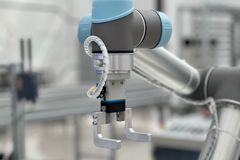
Vacuum grippers handle flat, smooth, non-porous surfaces extremely well and are common in parcel handling for that reason.
They struggle with fabric, mesh, irregular shapes and anything dusty, where a seal cannot form. Fingered grippers cope better with those but need more precise positioning.
Many practical systems now combine both, selecting an approach per object, which trades mechanical simplicity for broader coverage.
Tactile sensing is improving but immature
Human grasping relies heavily on touch, adjusting grip force continuously as slip begins. Most robots operate largely blind at the fingertips.
Tactile sensors exist, including designs that image the deformation of a soft surface, but durability and cost have slowed their adoption in production settings.
Without touch feedback, a robot must either grip conservatively, risking damage, or loosely, risking dropping, with no way to find the boundary.
Learning helps where modelling does not
Approaches that learn grasping from large quantities of trial data have improved success rates on unfamiliar objects considerably, because they capture regularities nobody wrote down.
Collecting that data is slow, since it requires physical attempts, and results transfer imperfectly between different hands and different object populations.
The current picture is steady improvement without a general solution, which is why deployments still narrow the object range wherever possible.