Robotics
Force Control And Why Robots Press Too Hard
Position-controlled arms follow a commanded path regardless of resistance, so tasks involving contact require sensing force directly or building compliance into the tooling.
An industrial robot is designed to reach a commanded position and hold it against disturbance. That behavior is ideal for moving through air and actively dangerous when the tool touches something.
Stiffness is the default and the problem
A conventional controller measures the difference between commanded and actual joint angles and applies torque to close it. If an obstacle intervenes, it applies more torque rather than stopping.
Since the arm is rigid and the commanded position is unreachable, contact forces rise quickly, which is how parts are crushed and tooling is bent during a routine program.
The controller is not malfunctioning; it is doing exactly what position control means.
Assembly is a contact task disguised as a placement task
Inserting a shaft into a bore, seating a connector or fitting a panel all require the part to slide against another while forces are managed.
Human hands do this by feel, adjusting continuously with a compliance that requires no conscious thought. A position-controlled robot has neither the sensing nor the compliance.
This is why assembly automation lagged behind material handling for so long, despite being economically attractive.
Passive compliance is the cheap solution
A compliance device mounted between the arm and the tool allows small lateral and angular movement, letting the part align itself against chamfers rather than fighting the fixture.
It is inexpensive, requires no programming and cannot crash. It also cannot be adjusted mid-task or report what force was applied.
For a single well-understood assembly running in volume, passive compliance often outperforms an instrumented approach at a fraction of the cost.
Force sensing closes the loop
A sensor at the wrist measures forces and torques in several directions, allowing the controller to command a force rather than a position, or to blend the two along different axes.
A polishing task can then hold constant pressure against a surface whose exact position is unknown, and an insertion can search for alignment by feel.
Some arms estimate force from motor current instead, which avoids the sensor cost and delivers coarser resolution, adequate for collision detection and inadequate for delicate work.
Why this defines collaborative operation
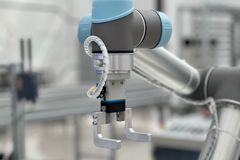
An arm intended to work near people must detect unexpected contact and stop or retreat, which is force sensing applied to safety rather than to the task.
The sensitivity required limits speed and payload, so collaborative arms occupy a distinct part of the market rather than replacing conventional ones.